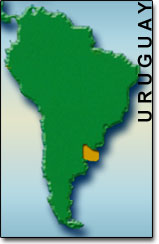
Uruguay offers the friendliest environment for foreign investors south of Rio Grande.
Uruguay is located in the southeast region of South America, between latitude 30º and 35º south and between longitude 53º and 58º west. It borders to the north with Brazil, to the east with the Atlantic Ocean, to the south with the River Plate and to the west with Argentina. Topographically it is located between the Brazilian plateau and the Pampa plains.
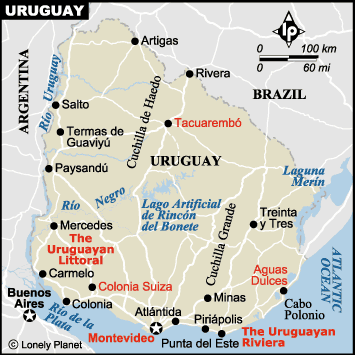
Its area is 176.215 square kilometers of plain pastures and low hills, which offer no great problem for raising, moving, and transporting cattle. It is much smaller in size than its neighboring countries, Brazil and Argentina. It is, though, larger than Cuba, Costa Rica or Nicaragua among other American countries, and larger than European countries such as Greece, Portugal, Austria, or Ireland. Holland, Belgium, Switzerland, and Denmark would all fit within its borders and there would still be plenty of space left.
The climate is temperate, rather humid and variable, with no major differences between summer and winter due mainly to sea influence. The average temperatures are 23º C (73ºF) in summer, 18º C (64 ºF) in autumn, 11º C (52 ºF) in winter and 17º C (63 ºF) in spring. Exceptionally, in summer temperature can reach 40º C (104 ºF) and in winter it can go down to 3º C (37 ºF). The average annual rainfalls are between 1,000 and 1,300 mm, with minor seasonal variations; less rain in summer than in winter. There are no important changes in temperature or in rainfalls within the different regions of the country. Snowstorms, hurricanes and earthquakes are unknown.
The total population was estimated in 1996 in about 3.164.000 inhabitants, 91% urban and 9% rural.
Uruguay was colonized by the Spaniards. During the XIX Century and the beginning of the XX Century it received a good number of both Spanish and Italian immigrants.
Montevideo, with a population of 1,5 million inhabitants, is the capital of Uruguay, as well as its main port and main city. It is also its political and economic headquarters. The country has a well-developed network of main roads as well as minor roads and is connected to Argentina by two bridges crossing the Uruguay River.